Concrete & Driveway Cleaning in Lexington, KY
Hot water and a commercial surface cleaner for driveways, sidewalks, patios, and pool decks — the one surface on your property that actually calls for real pressure, done evenly, without the streak marks.
Hot water cuts oil & grease
Cold water just spreads it around
No zebra stripes
Even color across the whole slab
Quoted before we start
An estimate you can trust
Why a Garden Hose Wand Fails
A hand-held wand at an angle leaves uneven "zebra stripes." A surface cleaner's spinning bars distribute pressure evenly across the whole slab instead.
Concrete looks indestructible, which is exactly why it gets neglected — years of oil drips, rust from an irrigation head, red clay tracked in on tires, and tire marks in the same parking spot all build up quietly until a driveway that was once the color of new concrete looks permanently stained. It's also the one exterior surface on a typical property that actually calls for real pressure, applied the right way, instead of the low-pressure chemistry used on siding and roofing.
Every Surface Is Different
Hard surfaces we clean around Lexington.
Concrete Driveways
Durable enough for a commercial hot-water surface cleaner at full working pressure — our main canvas for this service.
Asphalt Driveways
Held together by bonding agents that can break down under the same pressure concrete handles — asphalt gets a gentler approach and longer dwell time instead.
Sidewalks & Walkways
Usually bundled with a driveway, but a common standalone request before a home sale or a big gathering.
Patios & Pool Decks
Same hot-water treatment with extra care around coping stones, pavers, and any decorative concrete finish.
Stamped & Decorative Concrete
Textured surfaces trap more grime in the pattern grooves — cleaned at a lower pressure to protect the stamped finish.
Pavers & Natural Stone
Cleaned to lift dirt from the joints as well as the surface, since sand-filled joints hold as much grime as the stone itself.
What's the difference between cleaning concrete and asphalt?
Concrete is durable enough for a commercial surface cleaner at higher pressure. Asphalt is held together by bonding agents that can break down under the same pressure, so it needs a gentler approach and longer chemical dwell time instead.
Our Concrete Cleaning Method
Concrete is the one surface that actually needs pressure. Here's how we do it right.
Pre-treat stains
Oil, rust, red clay, and ground-in grime get the correct cleaning agent before the surface cleaner ever touches the slab.
Hot water surface cleaning
Overlapping passes with a surface cleaner at the correct pressure for the material — even color across the whole surface.
Edge & detail by hand
Edges, expansion joints, and tight spots cleaned with a wand — no untouched borders around a clean middle.
Rinse to drain
Everything rinses toward the street or a drain, away from the house and away from your landscaping beds.
Why a wand alone won't clean concrete the way people expect.
Cold water and a hand-held wand can blast a driveway for an hour and still leave visible stripes — a "zebra stripe" pattern that comes from holding the wand at even a slightly inconsistent angle. A commercial surface cleaner solves this mechanically: two spinning bars rotate under a steel hood, distributing pressure evenly across the entire width of the pass instead of concentrating it in one narrow line.
Heat does the rest of the work chemistry can't. Hot water breaks down oil, tire residue, and biological growth that cold water just spreads around the slab instead of lifting. We pre-treat heavy stains, run the surface cleaner across the full area, and post-treat with a brightener for rust or red clay — the goal is the original concrete color, not just a lighter version of the stain.
Stains We Treat
What actually shows up on a Lexington driveway.
Oil & Grease
Hot water cuts through petroleum-based stains that cold water just spreads across the slab.
Rust (Irrigation Drip)
A common Lexington driveway stain from sprinkler heads — treated with a targeted rust-lifting agent before the main clean.
Red Clay
Kentucky's clay-heavy soil tracks in from tires, mowers, and foot traffic and sits deep in the concrete's pores.
Tire Marks
Rubber transfer that builds up in the same parking spot over years — lifts clean with the right pre-treatment.
Algae & Moss
Shaded, damp areas of a driveway or walkway that stay slick and green without regular cleaning.
Efflorescence
The white, chalky mineral deposit that appears as moisture wicks up through concrete — it can return over time since it comes from within the slab, not the surface.
What is that white chalky residue that keeps coming back on my concrete?
That's efflorescence — a mineral deposit that forms as moisture wicks up through the slab and evaporates, leaving salts behind. Cleaning removes it, but because it comes from within the concrete rather than sitting on top of it, it can gradually reappear over time regardless of how well the surface was cleaned.
Algae and mildew buildup on a walkway or pool deck isn't just a curb-appeal issue — it's a slip-and-fall risk hiding in plain sight, especially on shaded concrete that stays damp longer after rain. Removing that biological growth also clears the mold and bacteria living in it, which matters more on a surface people actually walk across barefoot than most homeowners think about until someone slips.
Optional Add-On
Should you seal your concrete after cleaning?
Sealing isn't required, but it's worth understanding what it actually does: a quality sealant sits on top of freshly cleaned concrete and slows how quickly oil, rust, and clay can work their way back into the surface. It won't make concrete stain-proof — nothing does — but it meaningfully extends the time before your driveway looks the way it did before we cleaned it.
It's most worth considering on driveways with regular oil drip from an older vehicle, or on pool decks and patios that see constant foot traffic and sun exposure.
Should I seal my concrete after cleaning?
It's optional but recommended. Sealing after a clean extends the time before stains set in again and makes the next cleaning easier, though it doesn't make concrete stain-proof.
Honest Expectations
A few things worth knowing before you book.
New concrete gets a gentler treatment.
Concrete under about two years old is still curing. We won't run a high-pressure surface cleaner on it — just a chemical treatment and a low-pressure rinse instead.
Very old oil stains may lighten instead of fully disappearing.
We'll pre-treat every stain, but oil that's had years to soak into the concrete's pores sometimes leaves a faint shadow even after treatment. We won't promise 100% removal on something that deep.
Efflorescence can return regardless of cleaning quality.
Because that white chalky residue comes from moisture moving through the slab itself, it's not something a surface clean permanently prevents — it's a characteristic of the concrete, not a sign of a bad cleaning job.
Asphalt is treated differently than concrete, on purpose.
If your driveway is asphalt rather than concrete, expect a lower-pressure approach and longer dwell time. Running it at concrete-level pressure risks breaking down the bonding agents that hold asphalt together.
Real Results
Recent concrete cleanings around Lexington.
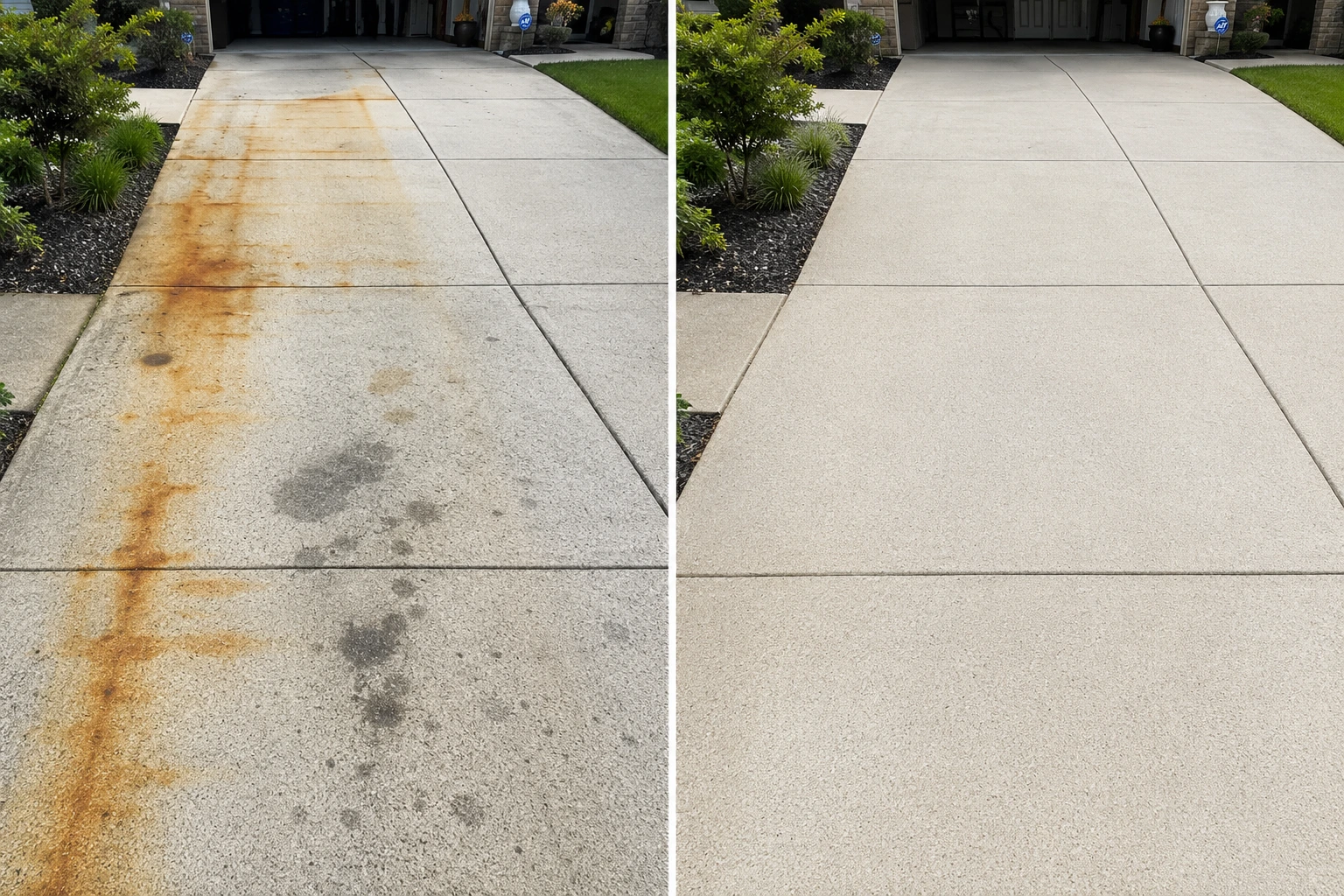
Ten Years of Rust & Oil Lifted
Irrigation rust drip and old oil stains removed before a family gathering — driveway and sidewalk both restored same-day.

Pre-Listing Driveway Refresh
Full driveway and sidewalk cleaning ahead of a home sale, paired with concrete sealing.
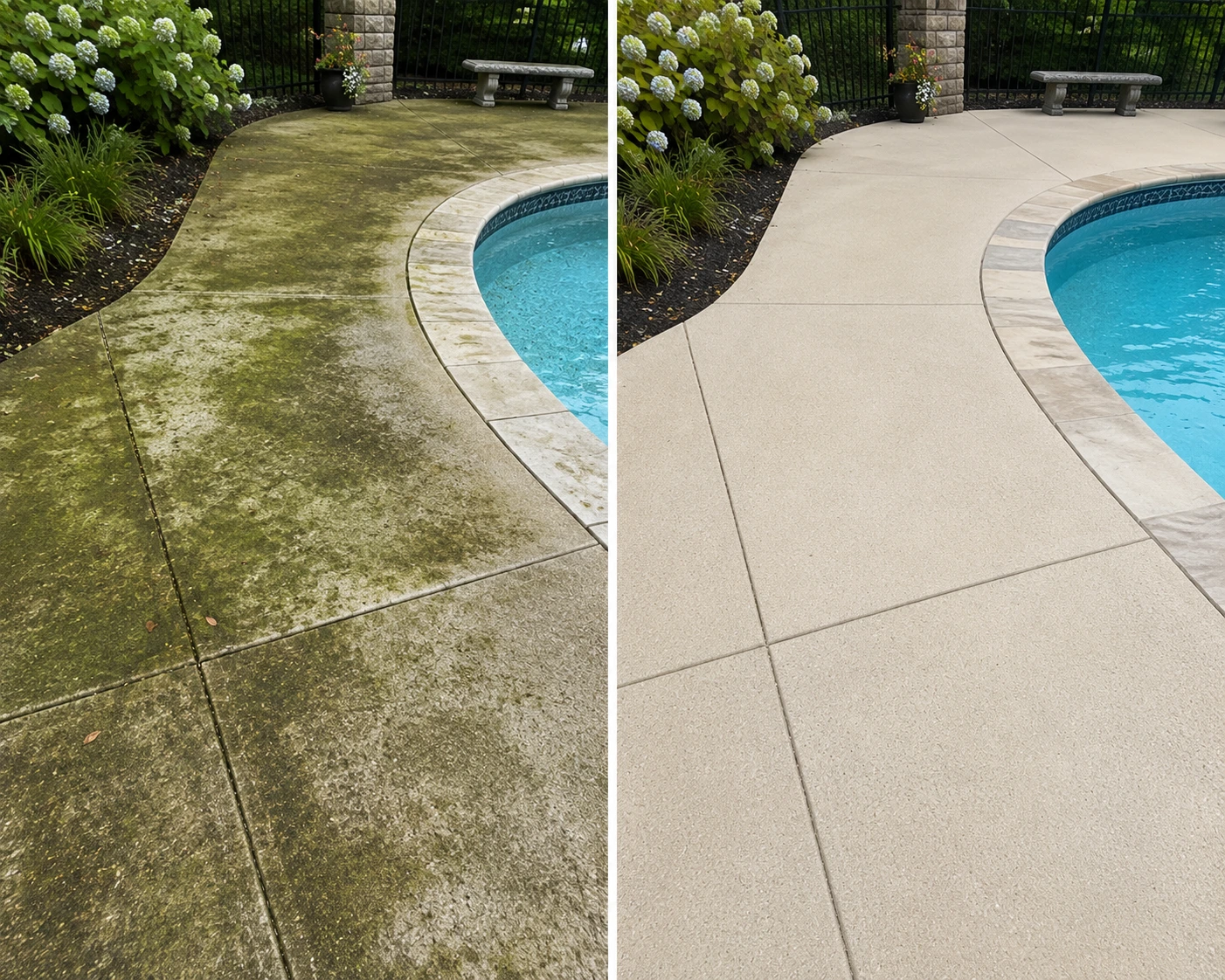
Pool Deck Restoration
Algae and grime removed from a shaded pool deck, with care taken around the coping stones.
Estimated Pricing
What concrete cleaning typically runs in Lexington.
These are estimate ranges — actual pricing depends on square footage, staining severity, and material. Larger areas are quoted per square foot, with an exact number in writing before anything is scheduled.
Two-car driveway, average condition
Est. $250–$450
Driveway + sidewalk combo
Est. $350–$600
Patio or pool deck
Est. quote per sq ft
Heavy oil/rust staining
Est. add'l pre-treatment
Asphalt driveway (gentler process)
Est. quote on-site
Concrete sealing add-on
Est. per sq ft add-on
Every Concrete Cleaning Includes
Save More
Bundle concrete cleaning and save 10–15%.
House Washing
Soft wash siding cleaning — often paired with a driveway visit for a full exterior refresh.
Learn more Add-On ServiceRoof Cleaning
Soft wash algae and moss removal for shingle, metal, tile, or cedar roofs.
Learn more Add-On ServiceGutter Cleaning
Interior clean-out and exterior brightening while we're already on-site.
Learn moreQuestions
Common questions about concrete cleaning.
Can you remove oil stains from concrete?+
Yes, in most cases. Hot water equipment is specifically effective on oil and grease, and we pre-treat heavy spots before cleaning so the stain lifts instead of just spreading. Very old, deeply set oil stains may lighten significantly without disappearing completely.
Will pressure washing damage my concrete?+
Standard cured concrete handles hot water surface cleaning without issue. New concrete under about two years old is treated differently — a chemical cleaner and low-pressure rinse only, no aggressive surface cleaner, since the surface is still curing.
How often should I have my driveway cleaned?+
Most Lexington driveways do well on an annual cleaning. Homes with heavy tree cover, an irrigation system prone to rust drip, or high vehicle traffic sometimes benefit from cleaning twice a year.
Do you clean pool decks?+
Yes — pool decks get the same hot water and surface cleaner treatment as driveways, with extra care taken around coping stones and any decorative finish.
Should I seal my concrete after cleaning?+
It's optional but worth considering. Sealing after a clean extends the time before new stains set in and makes the next cleaning easier — it doesn't make concrete stain-proof, but it meaningfully slows how fast staining comes back.
What's the difference between cleaning concrete and asphalt?+
Concrete is durable enough for a commercial surface cleaner at higher pressure. Asphalt is held together by bonding agents that can break down under that same pressure, so it needs a gentler approach and a longer chemical dwell time instead of brute force.
What is that white chalky residue that keeps coming back on my concrete?+
That's efflorescence — a mineral deposit that forms as moisture wicks up through the slab and evaporates, leaving salts behind on the surface. Cleaning removes it, but because it originates from within the concrete rather than sitting on top of it, it can gradually reappear over time regardless of how well the surface was cleaned.
Can you clean stamped or decorative concrete?+
Yes, at a lower working pressure to protect the textured finish — the pattern grooves hold more grime than flat concrete, so it usually takes a bit more dwell time to lift it fully.
Ready for a driveway the color of new concrete?
Hot water, real pressure, no zebra stripes — quoted before we ever show up.
100% Satisfaction Guarantee
Not happy? We come back and fix it. No questions.